


Boost Implant Conversions with Neutral Qualification
Dental Implants, Practice-Neutral Patient Qualification
Why Neutral Third-Party Qualification Converts Implant Patients Better Than Your Front Desk
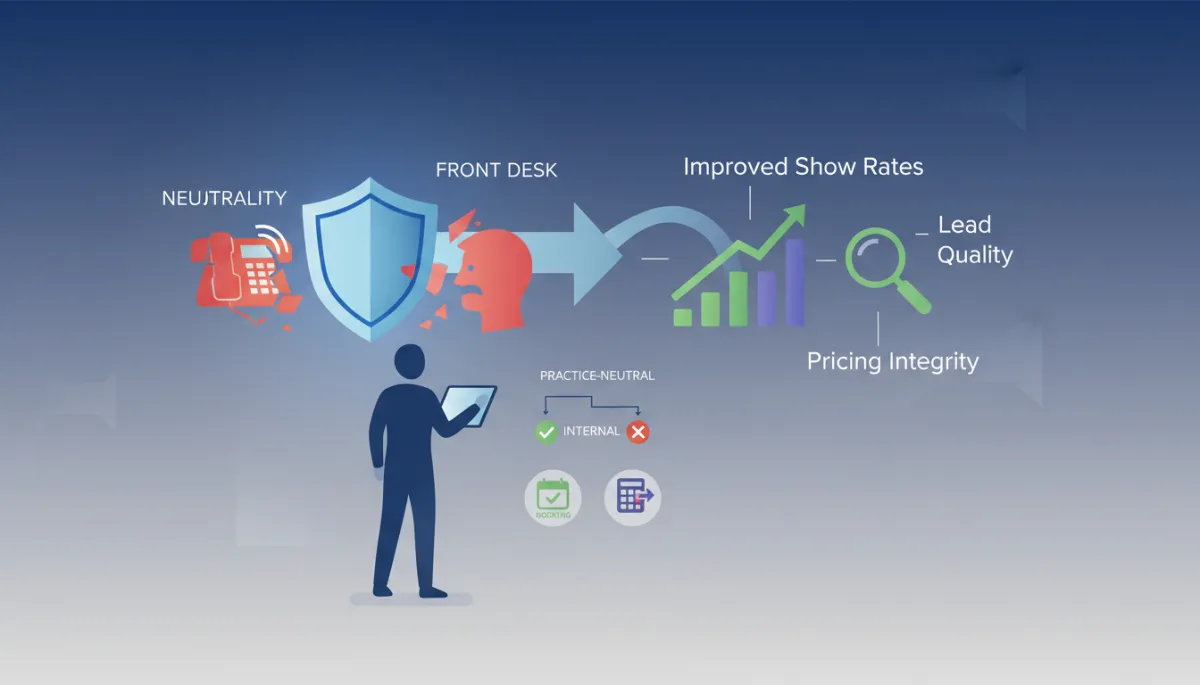
As a senior software engineer who lives in funnels, data, and conversion rates, I’m going to make a blunt claim: a truly practice-neutral patient qualification layer will almost always convert implant patients better than your front desk. Not because your team is bad people, but because the system you’ve put them in makes high-ticket, high-fear conversations almost impossible to handle objectively. In this article, we’ll unpack why practice-neutral patient qualification works, how DentPair and the Dent-IQ system operationalize it, and what this does to your numbers, show rates, lead quality, and pricing integrity.
The Uncomfortable Truth About Your Front Desk
If we were reviewing production logs instead of patient calls, you’d never accept what most front desks are doing to your implant pipeline. Industry data says that a “healthy” inquiry-to-appointment conversion rate in dentistry hovers around 60–66%, and implant-heavy practices often land between 50–65%. High performers can push toward 85% with tight systems and training. That means most practices are dropping 1 in 3 (or more) potential implant patients before they ever sit in the chair.
From a software perspective, your front desk is a noisy, stateful, multi-tenant service with no clear ownership and impossible SLAs. They are:
Handling insurance questions, reschedules, and complaints at the same time as high-ticket implant inquiries
Under pressure to “get them on the books” rather than qualify fit, intent, and financial readiness
Emotionally attached to “saving” the appointment, which subtly turns every call into a sales pitch
The result is predictable: patients feel sold, not served. They withhold key information about budget, fear, or competing consults, and they ghost you later. The uncomfortable truth is that your front desk is structurally incapable of being neutral, and neutrality is exactly what high-ticket implant decisions require. That’s where practice-neutral patient qualification comes in.
How Neutrality Changes the Conversation
When you introduce a practice-neutral patient qualification layer, you’re effectively adding a microservice between marketing and your schedule. This layer is not paid on production, does not work for the practice, and has no incentive to push a particular doctor or treatment. Its only job is to help the patient figure out whether implants are right for them and whether now is the right time to move forward.
That neutrality changes everything. Patients feel safe disclosing the real story:
What they can actually afford today versus “hoping insurance will cover it”
How many other consults they’ve already booked and what they’re comparing you against
Their true fears about surgery, time off work, or long-term maintenance
Practice-neutral patient qualification removes the sales aura from the call. Instead of “We’d love to get you in for a free consult,” the conversation becomes, “Let’s see if implants are a fit and which type of practice would serve you best.” That language is disarming. It encourages honest disclosures, which means by the time a patient reaches your chair, you’re not discovering landmines in real time—you’re reviewing a well-structured case file from someone who already knows the range of investment and the basic trade-offs.
💡 Pro Tip: If your intake process makes patients feel they’re being “closed,” they will either ghost or grind you on price. Neutrality flips that dynamic by aligning around the patient’s decision, not your schedule.
What This Does to Your Numbers (Show Rates, Lead Quality, Pricing Integrity)
Let’s talk metrics, because this is where practice-neutral patient qualification stops sounding “soft” and starts looking like engineering. In 2026, average dental inquiry-to-appointment conversion sits around 60–66%, with implant-heavy practices often lagging due to higher stakes and more shopping behavior. High-performing systems can push conversion toward 80–85% and simultaneously improve show rates. That’s not magic; it’s process.
A neutral layer like DentPair’s Dent-IQ system focuses on:
Improved show rates: Patients who’ve already had a long-form, non-sales conversation about goals, budget, and fit are far more likely to show. Some neutral systems report show rates around 80–85% for qualified leads, versus the 50–65% chaos many practices live with today.
Higher lead quality: Because practice-neutral patient qualification filters for intent, financial readiness, and timeline, your calendar fills with patients who are statistically more likely to start treatment, not just “get a quote.”
Pricing integrity: When the neutral party sets realistic investment expectations before the consult, your team is no longer pressured into discounting at the last minute to “save” the case. The patient walks in expecting a range that actually matches your fees.
Think of it like pre-validating API requests before they hit your core service. You reduce 400-level noise, protect critical resources, and keep your core system focused on doing what it does best: delivering clinical outcomes with 95–98% success over 10 years, instead of firefighting no-shows and tire-kickers.
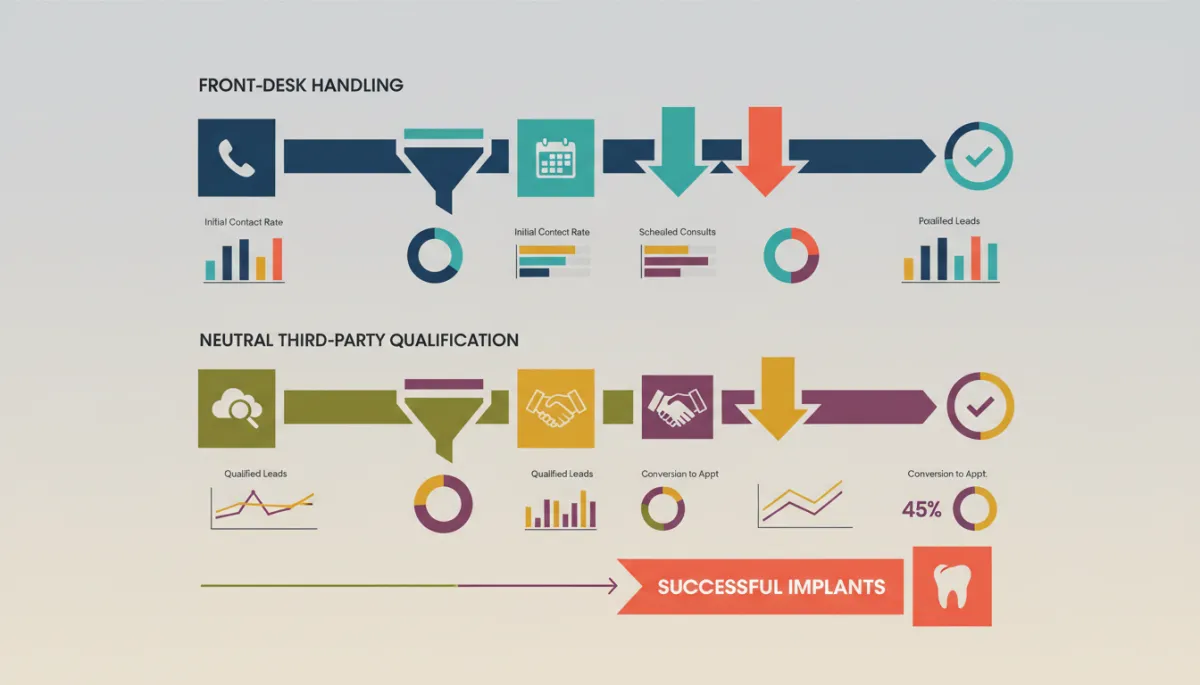
Practices that add a neutral qualification layer often see double-digit gains in show rates.
Can Your Team Replicate This Process Internally?
As engineers, our first instinct is, “We can build that.” But some properties are emergent, not easily simulated. Neutrality is one of them. You can script your front desk. You can hand them a checklist. You can even give them a “we’re just here to help you decide” talk track. But the patient still knows who signs their paycheck.
When an intake specialist’s email address ends in your domain, the patient assumes—correctly—that the goal is to get them into your chair. That assumption colors every answer they give. They round up their budget, understate their fear, and overstate their readiness, because they don’t want to disappoint or be sold. The neutrality of practice-neutral patient qualification cannot be faked because neutrality is not just a script; it’s a trust model backed by clear separation of incentives.
📌 Key Takeaway: You can copy the questions a neutral third party asks, but you cannot copy the fact that they don’t work for you. Patients intuitively feel that difference and respond with radically more honesty.
Inside DentPair and the Dent-IQ System: An Engineer’s View
Conceptually, DentPair with the Dent-IQ system behaves like an external decision engine for your implant pipeline. Marketing sends leads into Dent-IQ. The system combines structured intake flows, AI-driven pattern recognition, and human specialists to perform practice-neutral patient qualification, then passes only qualified, ready-to-talk patients into your schedule. Think of it as a dedicated service that owns the “pre-qualification” bounded context.
In pseudocode, the flow looks roughly like this:
def qualify_lead(raw_lead):
    profile = DentIQ.enrich_lead(raw_lead)
    score = DentIQ.score_intent(profile)
    budget_fit = DentIQ.assess_budget(profile)
    timing_fit = DentIQ.assess_timeline(profile)

    if score < 0.6:
        return {"status": "cold", "next_step": "nurture"}

    if not budget_fit or not timing_fit:
        return {"status": "not_now", "next_step": "education"}

    return {
        "status": "qualified",
        "next_step": "book_consult",
        "payload": {
            "goals": profile["goals"],
            "budget_range": profile["budget_range"],
            "fears": profile["fears"],
            "competing_consults": profile["competing_consults"],
        },
    }
In reality, Dent-IQ is more sophisticated, but the core idea is the same: centralize and standardize practice-neutral patient qualification in a dedicated system that is explicitly not your front desk. When a patient is handed off, your team receives a structured summary, not a vague “She sounded interested.”
Reactivating Cold Leads: Where Neutrality Quietly Prints Money
Most practices are sitting on a cold-lead graveyard: thousands of people who inquired about implants, never scheduled, or no-showed once and vanished. From a data-engineering standpoint, this is a massive, underutilized asset. The problem is that your brand is now associated with “the place that was going to sell me expensive implants,” so when your front desk calls back, it feels like a sales chase, not a fresh start.
DentPair’s neutral posture changes that. When a cold lead hears from a third party whose explicit role is to help them understand their options (not just at your practice), the emotional frame resets. It’s no longer “Are you ready to book with Dr. Smith yet?” but “Has anything changed in your situation, and do implants still matter to you right now?”
From a systems perspective, you can model this as a reactivation job that periodically re-queues cold leads into a neutral outreach workflow:
def reactivate_cold_leads(leads, months_idle=6):
    for lead in leads:
        if lead.months_since_last_contact < months_idle:
            continue

        if lead.status not in ("cold", "no_show", "not_now"):
            continue

        DentIQ.enqueue_outreach(
            lead_id=lead.id,
            reason="reactivation",
            channel_preference=lead.preferred_channel,
        )
Because the outreach is neutral, patients are more willing to say, “I couldn’t afford it then, but my situation’s changed,” or “I was scared of surgery; can we talk through alternatives?” That honesty lets Dent-IQ reclassify them from “cold” to “qualified” and send them back into your schedule with updated, reliable context. Reactivation is where practice-neutral patient qualification uncovers revenue you already paid to acquire but never converted.
Neutrality Cannot Be Faked or Replicated Internally
In security engineering, we talk about “trusted third parties” and “separation of concerns.” You can’t have the same process both generate and validate its own proofs without weakening trust. The same rule applies here: your practice cannot be both the seller and the neutral guide without patients discounting the neutrality part. They may not say it out loud, but their behavior will show it—guarded answers, price sensitivity, and ghosting when the numbers finally appear.
Practice-neutral patient qualification works precisely because the entity doing the qualification has no stake in whether the patient chooses you, another practice, or waits a year. That structural separation is what creates the safety for real disclosure. You can’t replicate that internally any more than a company can run its own “independent” audit and expect Wall Street to treat it as unbiased.
“Neutrality is not a script; it’s an incentive structure.”
That’s why attempts to “sound neutral” from inside the practice typically fail. Patients are smart. They recognize when the outcome still benefits the person asking the questions. With a system like DentPair and Dent-IQ, neutrality is baked into the architecture: different brand, different incentives, different mission. That’s not a UX tweak; it’s a protocol change.
Why Neutrality Is a Strategic Advantage, Not Just a Nicer Experience
When you zoom out, practice-neutral patient qualification is not just about kinder conversations. It’s a strategic moat. Any practice can buy more ads. Any practice can train the front desk to “smile more on the phone.” But very few will build or adopt a truly neutral, third-party qualification layer and stick with it long enough to compound the data and trust advantages.
Better data: Neutral conversations generate cleaner, more honest data about budget, fears, and decision timelines. That data feeds back into Dent-IQ’s models and your own planning, improving everything from offer design to staffing.
More efficient marketing spend: If you can move from 60–65% conversion of inquiries to something closer to 80–85% on qualified leads, your effective patient acquisition cost drops significantly without spending another dollar on ads.
Defensible differentiation: “We partner with a neutral third party to help you decide if implants are right for you” is a very different story than “We do free consults.” It signals confidence and respect for the patient’s autonomy.
In competitive implant markets—where multiple practices are fighting over the same high-intent leads—this neutrality becomes a strategic advantage. It’s harder to copy than a new ad campaign, and it compounds over time as more patients share that they felt genuinely guided, not sold.
Next Steps: See the Numbers for Your Practice
If you’re reading this as a data-minded owner or operator, you don’t need more philosophy—you need to see the delta for your own funnel. The fastest way is to model what practice-neutral patient qualification could do to your show rates, lead quality, and pricing integrity using a simple calculator. Plug in your current inquiry volume, show rate, and start rate, then estimate what happens if a neutral layer like DentPair’s Dent-IQ system nudges those numbers toward high-performing benchmarks.
You can run the math yourself, or use the built-in tools provided for you: visit the ROI calculator at calculator and see how many additional implants you could realistically start each month by inserting a neutral layer between your marketing and your schedule.
If you want to go deeper and see how DentPair and Dent-IQ would plug into your existing systems, schedule a practice-neutral strategy session at /booking1 . You’ll walk away with a clear blueprint of where your current front-desk process is leaking implant revenue, and how a neutral qualification layer can patch those leaks without burning out your team.
💡 Final Thought: You’ve already engineered a clinical system that delivers 95–98% implant success over a decade. Now it’s time to engineer the front end of that system with the same rigor—starting with a truly practice-neutral patient qualification layer that your front desk simply cannot replicate.
